
When Sad Cat Studios and publisher Thunderful Publishing released Replaced in April, the 2.5D pixel-art action adventure quickly revealed an unexpected production challenge: its lore system had grown out of control. The narrative team wanted an expansive set of collectible story entries, all presented through a visually rich interface that matched the game’s cyberpunk-noir identity—but the ambition came at a cost. The more features were added, the more the UI and animation workload began to swell.
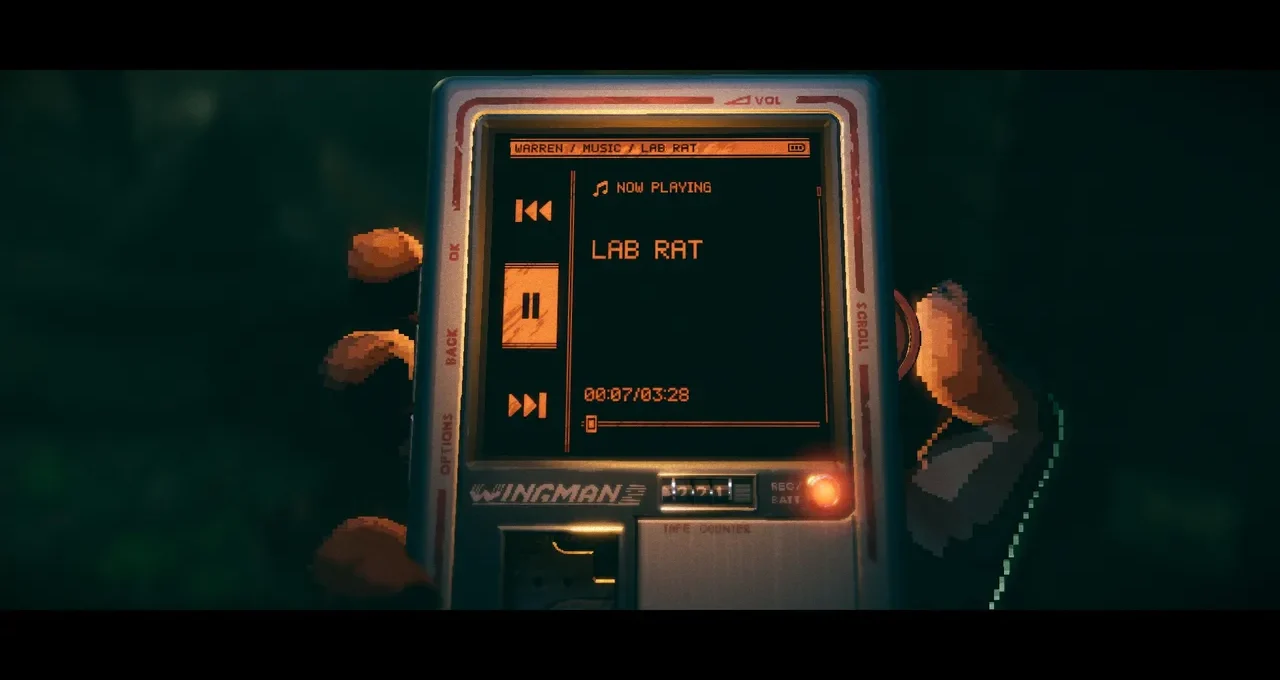
To solve the problem, game director Yura Zhdanovich looked outside traditional UI design for inspiration, drawing from retro devices like the Game Boy Camera and Sony’s Walkman. The result was a clever in-universe solution: a multifunctional gadget called the Wingman, which reimagines how players interact with lore, music, and scans without relying on layered menus or traditional overlays.
The Wingman can be accessed at any time during exploration, instantly shifting the camera into a first-person perspective focused on protagonist Reach’s hand interacting directly with the device. Instead of abstract UI screens, players see a stylized, tactile interaction—complete with hand animations that emphasize physicality and presence within the world.
According to Zhdanovich, the system also helped streamline production. “The hand animation itself is a heavily stylized 3D model with full-screen pixel post processing—that pipeline made iteration much easier,” he explained. Because most of the game’s action keeps characters at a distance, the Wingman naturally becomes a visual focal point, standing out as one of the few intimate, close-up interactions in the experience.
Originally, the team experimented with more complex item inspection systems, where different categories of collectibles would require unique animation sets. That approach quickly became unsustainable. The Wingman simplified everything: once an item is scanned, it is automatically stored within the device, centralizing all lore and collectibles into a single, unified hub.
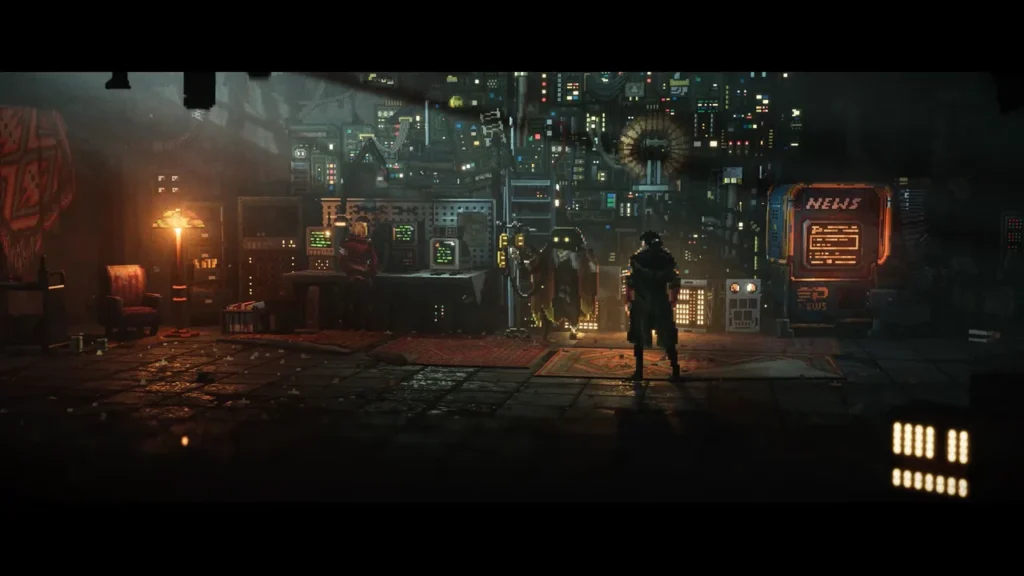
A key part of its design is the physical scroll wheel on the side of the device. As players move through entries or music tracks, Reach’s hand follows each motion with corresponding animation, reinforcing the illusion of a tangible, handheld gadget. The inspiration from retro tech like the Sony Walkman is clear, especially in the way the device emphasizes tactile interaction in contrast to modern touchscreen minimalism.
Zhdanovich noted that this emphasis on physicality was intentional. “Nowadays we have lots of fidget toys that are here to compensate for the lack of tactile interactions with objects and tech,” he said. “Everything we do on our smartphones is just tapping and swiping. You don’t get that satisfying snap anymore. Making the Wingman tactile was our way of bringing that feeling back.”
Because the Wingman shifts the player’s perspective when used, the team also had to account for technical and visual edge cases. NPC positions, environmental geometry, and interaction timing all had to be carefully managed so that activating the device wouldn’t break immersion or produce awkward camera transitions. The system doesn’t pause gameplay entirely, which required additional design constraints, including areas where the gadget cannot be used safely.
Another major consideration was readability. While the interface draws inspiration from early digital devices like the first-generation iPod, the team had to carefully balance style with clarity. With limited screen space and a diegetic presentation, ensuring text remains legible became a constant design constraint.
Some ideas ultimately didn’t make it into the final version of the Wingman. Early plans included mini-games, deeper system settings, and even a fully animated cassette-swapping sequence for music playback. A hacking module was also planned for launch but has since been pushed to a post-release update.
Interestingly, the Wingman concept arrived relatively late in development, but its introduction helped unify several disparate systems already in progress. Features like video-call-style narrative sequences naturally fit into its framework, turning what could have been separate UI elements into a cohesive in-world device.
For the development team, the Wingman ultimately became more than just a UI replacement—it became a guiding design principle. As Zhdanovich put it, the goal was to avoid creating unnecessary systems and instead maximize what already existed, ensuring everything supported the game’s core identity rather than competing with it.